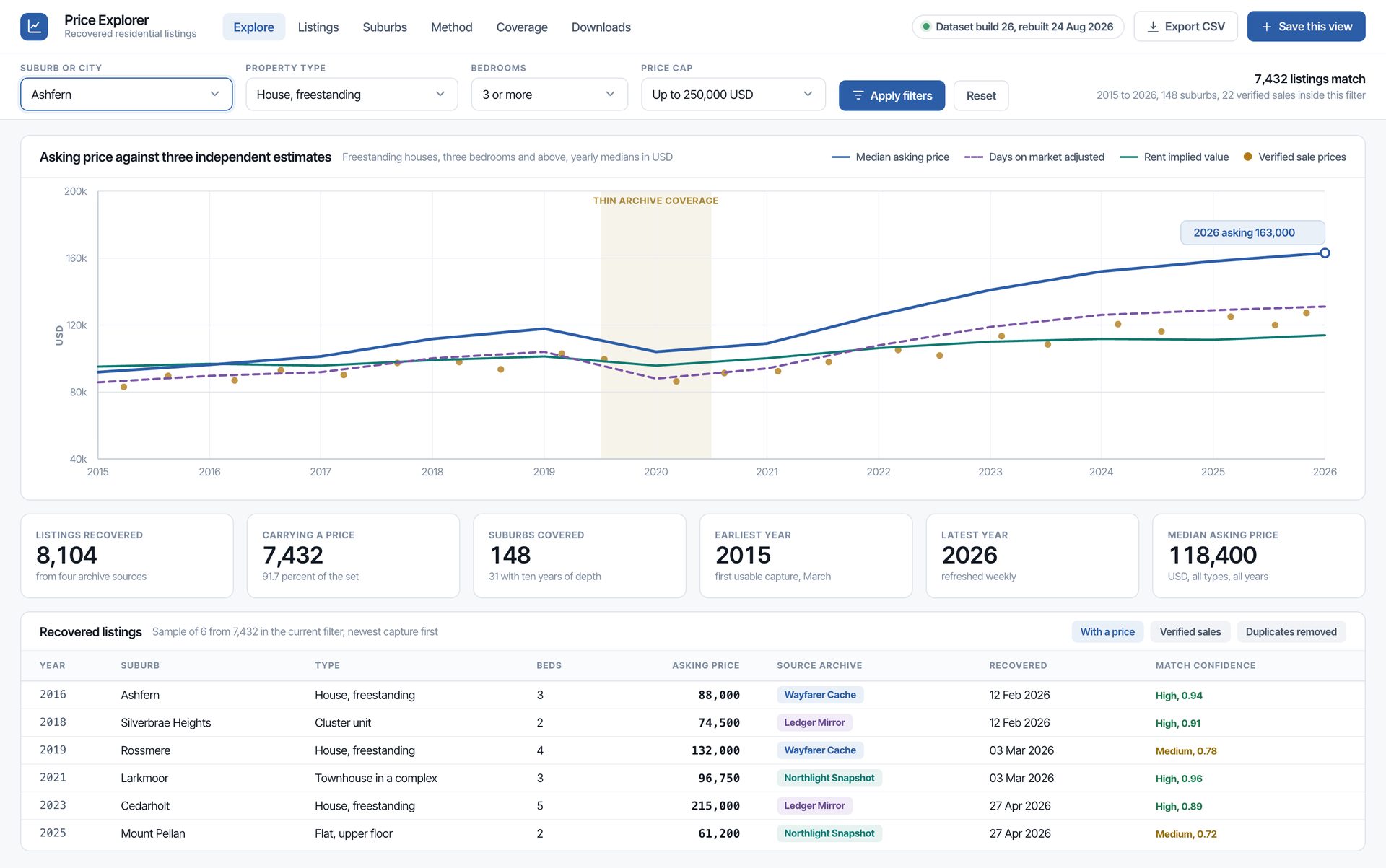
Zimbabwe publishes no sale prices. Valuations rest on asking prices and on what an agent remembers. Worse, a listing disappears from a portal when the property sells, which removes exactly the evidence a valuation needs at exactly the moment it becomes useful.
A recovery pipeline that reconstructs listings from web archives after they have been taken down, across the country's main portal and five competitors, then a model estimating what properties actually sold for against what was asked for them.
A dataset spanning more than two decades and more than twenty suburbs, with a sale-to-asking estimate that five independent methods agree on.
Recovery figures are counted from the dataset itself. The sale-to-asking range is where five independent methods converged, and the study records its own scoring of them as six strong passes, two acceptable and one weak. We publish the weak one because a range nobody can interrogate is worth less than a narrower claim that survives being checked.
This page once carried claims that described the work inaccurately. They came down in an audit of our own copy, and each one went back up only when its numbers could be traced to something measured. A case study you cannot check is worth nothing to you, and one that turns out to be wrong costs us more than it ever earned.