The portal already ranked 2nd to 6th on Google for more than four thousand property keywords, and was producing content one article at a time: one freelancer, two weeks, around $200 each.
The market position is Bloomberg's own editorial description, 9 May 2025, rather than the company's claim about itself. Listings and agencies were counted from the live site on 26 August 2026 and drift by around ten percent. The keyword count is the client's own baseline going into the work, and it describes what they already had rather than anything this produced.
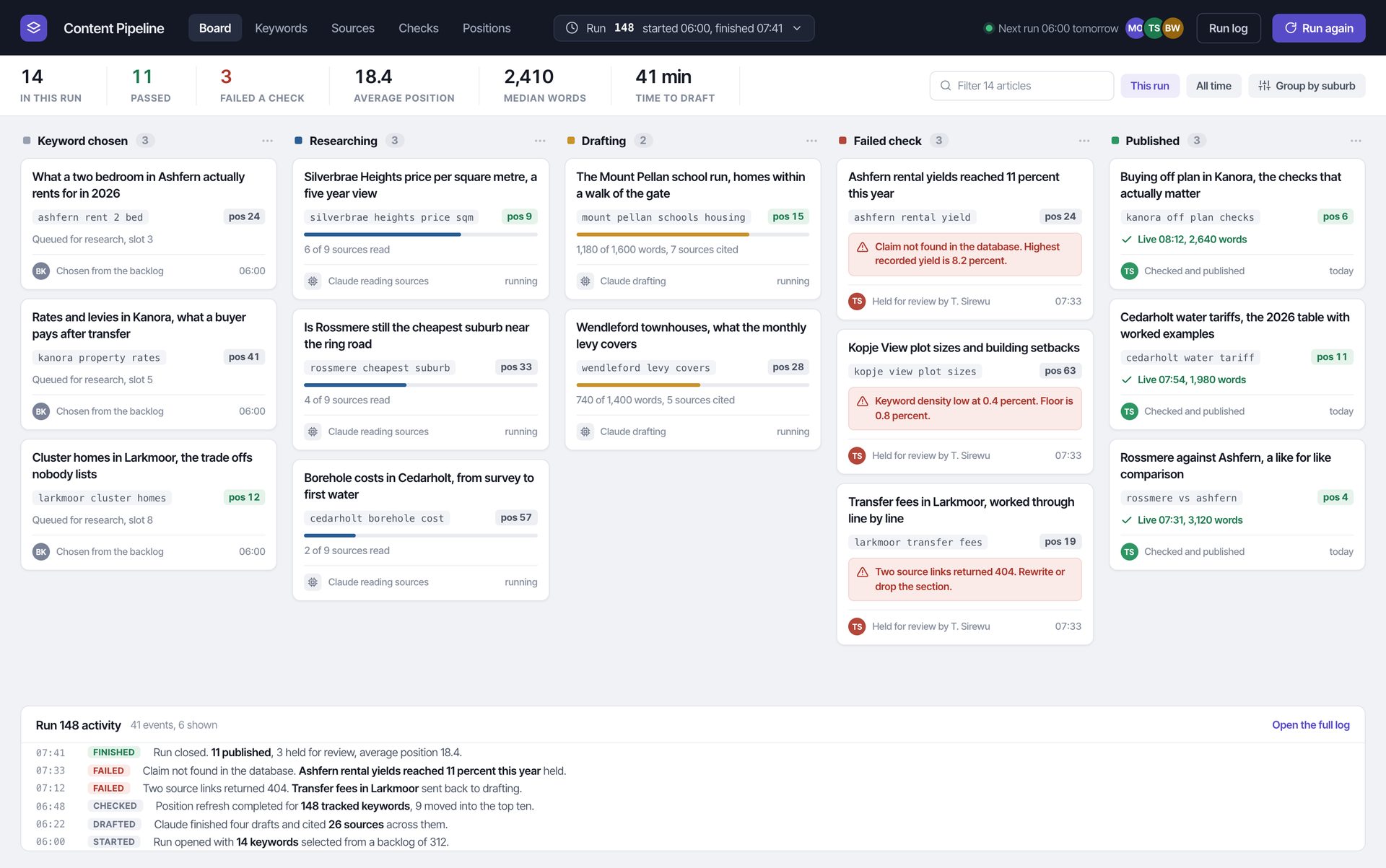
A six-stage pipeline. It picks the keyword, scrapes the competing pages, queries the portal's own listings database for figures nobody else has, assembles the expertise signals Google looks for, generates the article, and QA-checks it before it reaches the CMS.
The pipeline was prototyped in under a fortnight and the prototype became the production system. Each stage below is a real step with a real tool behind it.
| Term | Rank now | Worth writing |
|---|---|---|
| A suburb plus a property type | 4 | Yes |
| A broad national term | 38 | No |
| A suburb plus a price question | 6 | Yes |
| A term with no volume | 2 | No |
Search Console and ahrefs are scored together across more than four thousand terms the portal already ranked for: search volume, competition, the position it currently holds, and what that position is actually worth in clicks.
A term sitting fourth with real volume is worth writing for. A term sitting fortieth is not, however interesting it is, and no writer chooses that way on their own.
| Page | Covers | Misses |
|---|---|---|
| Ranking first | Prices, schools | Transport |
| Ranking second | Prices | Schools, transport |
| Ranking third | Agent listings | Anything factual |
| The gap | Transport and commute |
The top pages for that term are pulled and fetched in full. Claude reads them for what they cover, how they are structured, and what none of them answers.
The gap is the brief. Nobody writes a brief by hand and nobody starts from a blank page.
-- generated for: a suburb guide
SELECT   property_type,
         COUNT(*)          AS listings,
         MEDIAN(price)     AS median,
         MEDIAN(bedrooms)  AS beds
FROM     listings
WHERE    suburb = :suburb
  AND    listed_at > NOW() - INTERVAL '12 months'
GROUP BY property_type

-- every number in the finished article traces to a row this returnedClaude generates a query against the portal's live listing database and gets back real numbers for that suburb: what things are actually selling for, what is on the market, how that has moved.
This is the step that makes the output worth reading. An article about a suburb written from the portal's own listings says something no general-purpose writer can say.
Google Maps supplies what is actually around: the schools, the shops, the routes in and out.
The article format is then chosen from what the search intent was. A neighbourhood guide, an investment analysis and a buyer's guide are different articles, and the pipeline decides which one it is writing before it writes.
Claude produces the article as structured data rather than as prose: a headline, an introduction, sections, a meta description, questions and answers. Structure means it lands in the CMS as a draft rather than as a wall of text somebody has to reformat.
Then a second, separate pass checks it: keyword use, the signals search engines look for, the client's voice, and every factual claim back against the database it came from. Roughly 8% failed and went back.
| Stage | Person needed |
|---|---|
| Choosing the keyword | No |
| Research and brief | No |
| Writing | No |
| Reading what failed the check | Yes, the 8% |
| Deciding to publish | Yes, every one |
This is the stage that decides whether a pipeline like this is worth building. Reviewing every article is a job. Reviewing the ones an automated check flagged is an afternoon.
Then the rank is watched, and what moved decides what gets written next month. The last stage is the first stage.
450 articles were researched, written and checked in 48 hours and went into the content system as drafts for the client to review and publish. The year that followed shows it: the portal published 133 articles in 2025 against 53 the year before. The process it replaced was one freelancer, two weeks, and around two hundred dollars an article.
The 450 figure and the 48 hours are the client engagement's own record. The published article counts were counted from the portal's live sitemap on 26 August 2026: 53 articles dated 2024 and 133 dated 2025. The 450 were drafts for review, and the entry says drafts because that is what they were.
This page once carried claims that described the work inaccurately. They came down in an audit of our own copy, and each one went back up only when its numbers could be traced to something measured. A case study you cannot check is worth nothing to you, and one that turns out to be wrong costs us more than it ever earned.